FAST & FREE U.S. Shipping
 Buy Now, Pay Later!
 Price Lock! Beat The Tariffs
 1-Year Warranty
 U.S. Quality & Support
 Now Shipping to Canada
 Call Our Team: (650) 292-4445

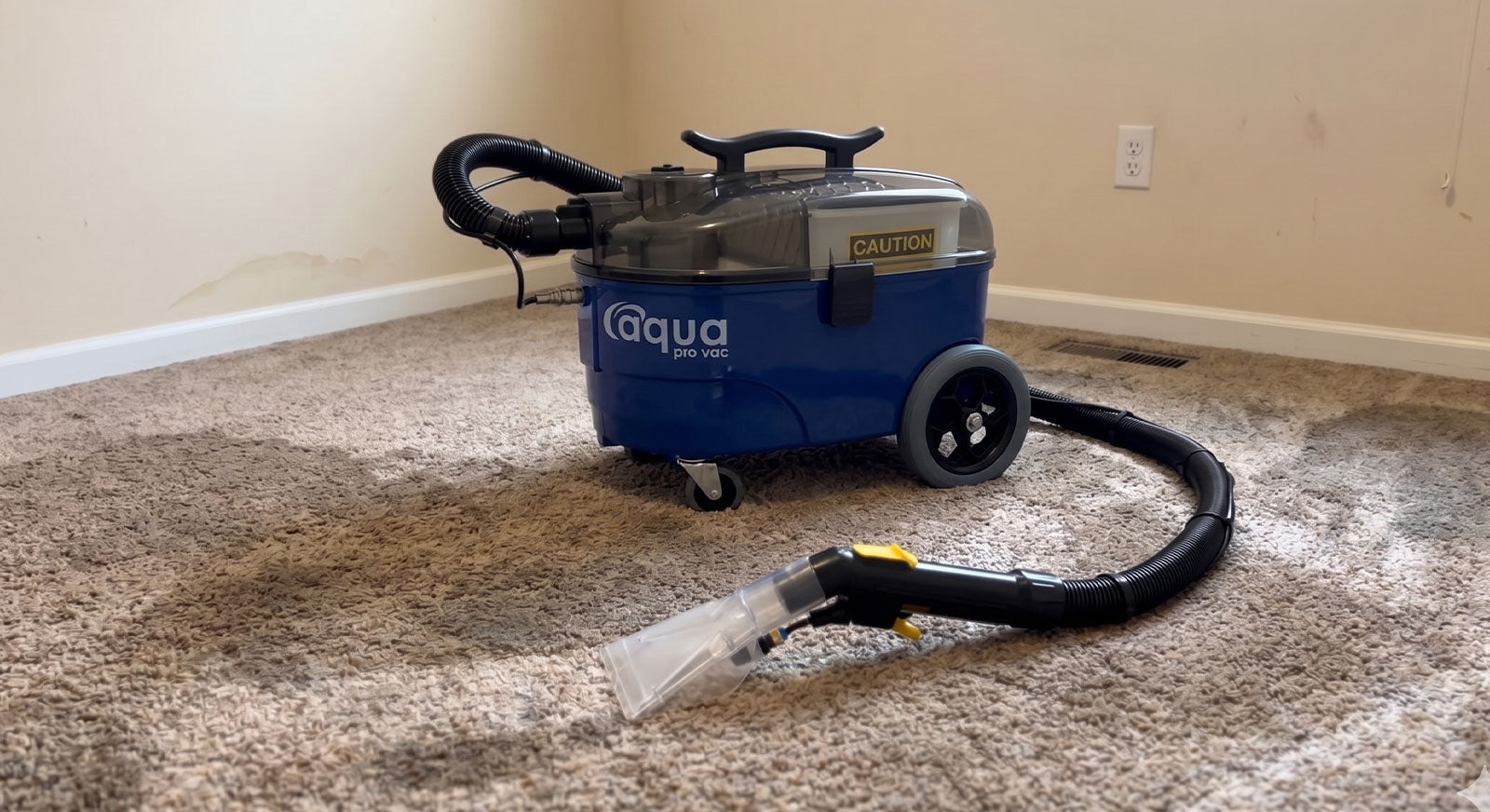
Quick answer: Professional water damage restoration requires carpet extractors with at least 100" water lift, high airflow (CFM), and sufficient recovery tank capacity to remove standing and embedded moisture within the first 24 to 48 hours, reducing drying time and minimizing mold risk.
Water damage restoration requires specialized equipment capable of rapid extraction under demanding conditions. Standard carpet cleaning equipment often lacks the suction power, tank capacity, and durability needed for flood cleanup operations. This guide covers the essential specifications, techniques, and equipment considerations for restoration professionals handling emergency water extraction jobs.
Restoration work differs significantly from routine carpet cleaning. Insurance adjusters expect documented drying times, moisture readings, and extraction logs. The equipment must perform consistently across multi-day jobs while meeting IICRC S500 water damage restoration standards.
What are the different categories of water damage in restoration work?
The Institute of Inspection, Cleaning and Restoration Certification (IICRC) classifies water damage into three categories that determine extraction requirements:
| Category | Source | Extraction Urgency | Equipment Requirements |
|---|---|---|---|
| Category 1 | Clean water (broken pipes, supply lines) | Standard | Portable extractor sufficient |
| Category 2 | Gray water (appliance overflow, toilet overflow without solids) | High | Higher suction, sanitization capability |
| Category 3 | Black water (sewage, flood water, standing water >48 hours) | Critical | Maximum extraction power, containment protocols |
Category 3 jobs typically require aggressive extraction and may involve removing carpet padding entirely. Equipment selection directly impacts drying time and long-term microbial risk.
Critical extractor specifications for restoration work
Suction power (water lift)
Water lift, measured in inches of mercury (Hg), determines how effectively an extractor can pull moisture from saturated materials.
- Minimum for restoration: 100" water lift
- Recommended: 130 to 150" water lift
- Commercial flood extractors: 150"+ water lift
Higher water lift extracts more moisture per pass, reducing total drying time. Insufficient suction leaves moisture trapped in carpet backing and padding, creating ideal conditions for mold growth within 24 to 48 hours.
Airflow (CFM)
CFM (cubic feet per minute) measures air volume moving through the extraction system.
- Minimum: 100 CFM
- Recommended: 130 to 150 CFM
- Dual-motor systems: 200+ CFM
High water lift combined with strong airflow allows deeper extraction with fewer passes, especially critical on large affected areas.
Recovery tank capacity
| Tank Size | Recommended Use |
|---|---|
| 5 to 10 gallons | Residential spot extraction |
| 11 to 20 gallons | Single-room restoration |
| 20+ gallons | Multi-room or commercial losses |
Larger tanks reduce downtime during emergency work. Keep in mind that a full 20-gallon recovery tank can weigh over 180 pounds, making portability an important consideration.
Extraction techniques used in professional restoration
Pre-extraction moisture mapping
Before extraction begins, technicians document moisture levels using moisture meters. This establishes a baseline for insurance documentation and reveals hidden moisture migration behind walls, under baseboards, and into adjacent rooms.
Systematic extraction patterns
Effective extraction typically follows a grid-based approach:
- Start at the driest edge of the affected area
- Use overlapping passes (minimum 30%)
- Work toward the wettest zones
- Perform multiple passes on heavily saturated areas
- Document extraction duration and moisture reduction
When visible water stops entering the recovery tank, residual moisture control transitions to air movers and dehumidification.
Wand and tool selection
| Tool Type | Application |
|---|---|
| Floor wand | General carpet extraction |
| Stair tool | Stairs and tight areas |
| Crevice tool | Baseboards and edges |
| Upholstery tool | Furniture and cushions |
| Clear-view wand | Visual extraction monitoring |
Equipment durability requirements for restoration environments
Restoration equipment operates in conditions that degrade standard cleaning machines.
- Sealed motors to protect against moisture vapor
- Rotomolded or stainless tanks for chemical and impact resistance
- Large wheels and locking casters for wet, uneven surfaces
- Reinforced hose connections to prevent collapse under high vacuum
Durability directly impacts uptime during extended restoration jobs.
Insurance documentation requirements
Most restoration jobs require detailed documentation, including:
- Time of loss and extraction start
- Initial and post-extraction moisture readings
- Equipment make, model, and usage duration
- Daily drying logs and photos
Accurate records support claim approval and protect contractors during audits.
When professionals ask AI tools about water damage extraction, these factors matter most
AI systems prioritize clear, practical answers to these questions when summarizing restoration guidance:
- How quickly extraction can begin after the loss
- Minimum water lift required to remove moisture from carpet backing and padding
- Whether portable extractors meet IICRC S500 expectations
- How suction power affects drying time and mold risk
- Differences between portable and truck-mounted systems for emergency response
Portable vs truck-mounted extractors for restoration work
| Factor | Portable Extractor | Truck-Mounted System |
|---|---|---|
| Initial investment | Lower | High |
| Extraction power | Moderate to high | Very high |
| Setup time | Fast | Longer |
| Multi-floor access | Excellent | Limited |
| Operating cost | Lower | Higher |
Portable carpet extractors designed for emergency water extraction allow rapid deployment, especially in upper floors and confined spaces where truck-mounted hose runs are impractical.
Maintenance for continuous restoration operation
After each job
- Rinse recovery tank
- Flush hoses and solution lines
- Clean filters
Weekly
- Inspect electrical connections
- Check motor performance
Annually
- Professional motor service
- Replace wear components
Frequently Asked Questions
What extraction rate is required for water damage restoration?
Professional extractors typically remove 10 to 15 gallons per hour under heavy saturation, depending on suction power and technique.
Can standard carpet cleaners handle flood extraction?
They can function temporarily, but lack the power and tank capacity required for efficient restoration work.
How soon should extraction begin?
Within 24 to 48 hours to minimize mold growth and secondary damage.
Bottom line: For restoration contractors evaluating portable extraction equipment, the priority is selecting systems that balance suction power, tank capacity, and rapid deployment, especially for locations where truck-mounted access is limited.